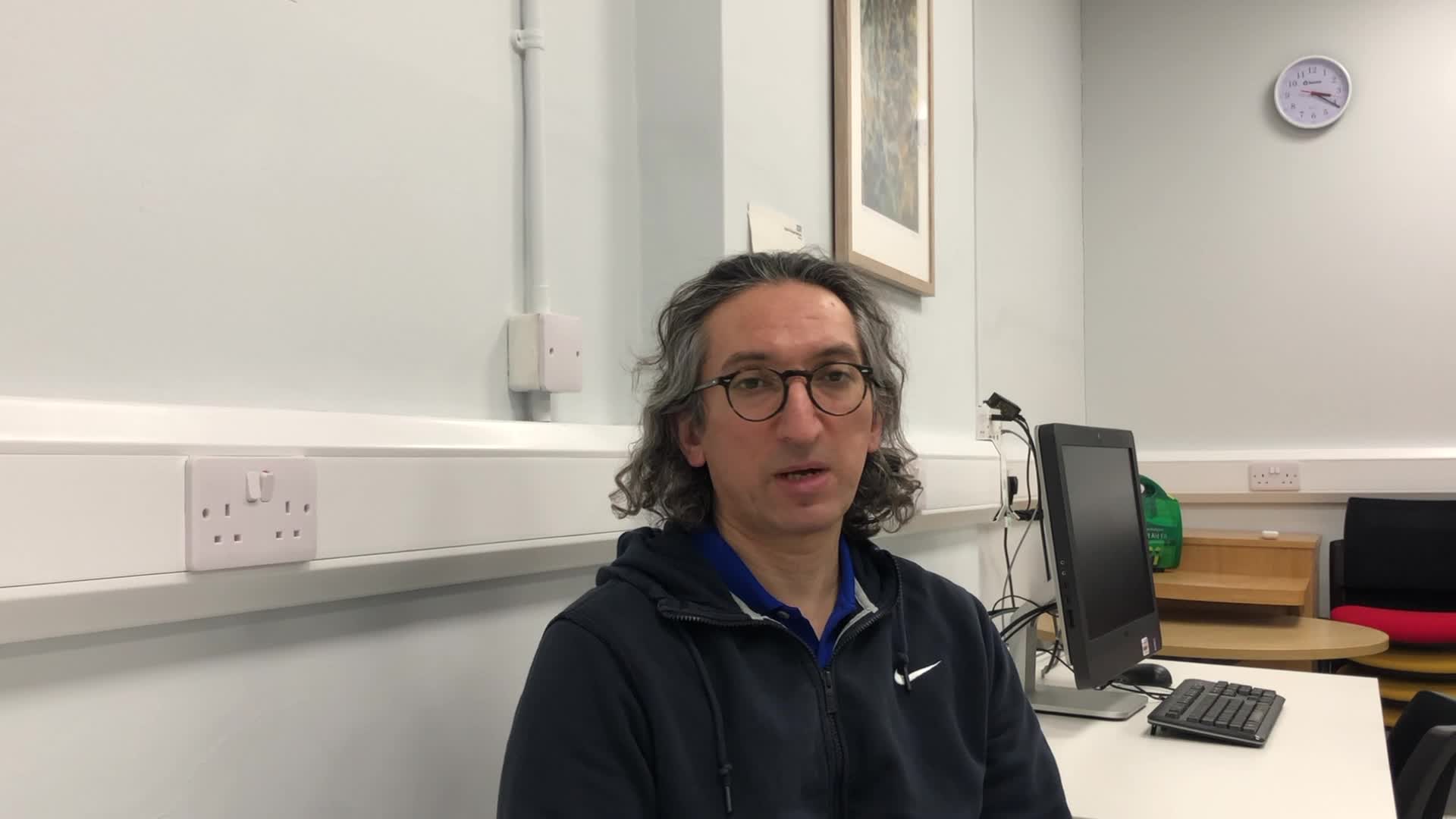
A short video by Mr Usman Jaffer explaining what varicose veins are.
Transcript (auto-generated)
This transcript was generated automatically and may contain errors.
Welcome to the vascular clinic. We specialize in vascular care, particularly treatment of varicose veins. We offer timely, price-transparent and courteous treatment here. We're based in London. We also see patients in Birmingham and Manchester and we're very happy to see you at one of our clinics. What are varicose veins? Varicose veins are what we call superficial dilated tortuous veins in your lower legs. What that means is you can see large protruding veins down the course of your leg from the groin area down to the ankle area. And they can be in the front of the leg or the back of the leg, depending which system of veins is affected. The anatomy of the venous or the vein system of the legs is such that veins are disposed into what we call superficial veins, veins just as the skin, and deep veins. Deep veins lie in the muscles of the leg. This superficial and this deep system are linked by what we call communications. The communications can be at three or two major groups of junctions. The first junction is where the superficial veins meet the deep veins, and that happens in the groin area. That's called the saphenopopatial junction, and in the behind the knee joint, and that's called the saphenopopatial junction. So, saphenofemoral and saphenopopatial junction. There are also other sites of communication between veins, and they are what we call perforating veins. Now, normally, most of the blood flow is in the deep veins, and the job of the veins is to take blood back to the heart. The arteries circulate blood down towards the end of the limbs, and the veins take the blood back. The majority of the blood is is carried by the deep veins. The superficial veins also play a part. But normally the blood travels from the superficial veins, that is to say the veins underneath the skin, just beneath the skin, and they travel deep into the deep veins of the leg. Blood doesn't flow the other way normally because of valves, and these valves, competent valves, prevent the reflux of blood up into the superficial veins. If these valves become non-functioning for whatever reason, then blood abnormally flows from deep to superficial, i.e. from in the muscular veins to the veins under the skin. And that can happen at one of the junctions, either in the groin area or in the knee joint area, or at one of these perforating veins. When we see patients with varicose veins, it's very important to diagnose the points at which this reflux or abnormal flow is occurring. And our job as surgeons is to treat that reflux, so remove the opportunity for the blood to flow in the wrong direction. And usually, that occurs by removing or ablating or burning, using keyhole techniques, the superficial veins, the veins under the skin. The next video is about the difference between what we call varicose veins and thread veins. Thread veins typically are veins in the layer of the skin, actually the skin layer. They're very thin veins. Sometimes they're called starburst or spider or thread veins. These veins are different to varicose veins. Varicose veins are actually arising off one of the branches or components or main components of the superficial venous system. And varicose veins can give you symptoms. What sort of symptoms can they give you? We'll discuss that in another video. Varicose veins can give people problems in a number of ways. One problem could be simply, I don't like these protruding veins. They're causing me distress psychologically speaking, or I just don't like the look of them. And the symptoms and problems with varicose veins can range from that, i.e. I just don't like the sight of them to what we call venous ulceration, which is a breakdown of the skin because of excess pressure in the venous system. In between, there's a spectrum of disorders, or venous disorders, which include things like lipodermatosclerosis, which is a thickening and hardening of the skin and a deformation in the shape of the lower leg. Also it includes things like haemocidarin deposition, which is a staining of the skin, a brownish-bluish color. The next few videos are about treatment of your varicose veins. There are a number of ways of treating varicose veins. As I said in the previous video, some varicose veins occur because of reflux of blood, blood going in the wrong direction from the deep veins to the superficial veins. Now, these treatments can range from what we used to call open surgery under general anesthesia in the form of what we call a high sapheno-femoral ligation and stripping of the long saphenous vein, or sapheno-popliteal ligation, all the way to modern keyhole techniques. And I'll discuss these in sequence. The first modality of treatment of varicose veins I'd like to discuss is what we call ablation and ablation can be done using either a laser or a radiofrequency catheter. A catheter is a long sort of wire which delivers energy in this case. In terms of radiofrequency ablation, we use radio waves to heat up the tissue around the tip of the wire or catheter that we insert into the vein. laser, laser energy causes heating and damage to the vein that we want to ablate or destroy. The procedure begins by what we call cannulation. Cannulation is inserting a very fine needle into the vein at around the knee joint area. After a needle is inserted successfully into the vein, we advance what we call a guide wire up the vein into the groin area and position that conveniently for the subsequent procedure. After a wire is advanced, we then advance a small plastic tube over the wire that gives us access to the vein and the ability to pass the ablation catheter or laser fibre up the vein. We position the tip of the fibre away from the junction with the deep vein to avoid injuries to the deep vein and then we deliver energy or heat to the vein that we would like to remove or destroy or ablate. We destroy or ablate the vein sequentially down the leg until we reach the entry point where the needle entered the vein and then we remove our system. Traditional open surgery for varicose veins was known as a high tie and strip of long saphenous vein. In this operation, a small cut was made in the groin area and the long saphenous vein or the vein under the skin which ran up to the groin area was identified and separated from the deep veins in which it eventually drained into. The rest of the vein was stripped out of the leg and pulled out from another counter-incision in the knee area. This all had to be done under general anaesthesia and there was a certain amount of recovery involved. However, the procedure was very well established and we know pretty much the outcomes of this procedure long-term. As well as the sapheno-femoral junction, which is operation on the front of the leg, we can also operate on the saphenopopatial junction if a vein at the back of the calf, the short saphenous vein, was incompetent or leaky or the valves in that area weren't working properly. And that operation is done with a small incision, again under general anaesthesia, in the back of the leg in the knee area. The junction between the short saphenous vein, which is the main vein in the back of the leg with the deep veins in the knee area is identified. The two ends are divided and ligated, closed with surgical ties, and the skin is closed. And that's the end of that operation. What these two operations did achieve very effectively was disconnection between the superficial, i.e. the venous system under the skin and the deep system in the muscles. The objective was to relieve the pressure on the venous system under the skin and therefore prevent some of the changes or complications that can occur with varicose veins. This video is all about foam sclerotherapy. Foam sclerotherapy is a very minimally invasive technique. It's achieved by simply placing a needle into the varicose vein and injecting a foam mixture of a sclerosin agent which is damaging to the lining of the vein with air or carbon dioxide and the process of creating foam from that chemical mixture provides the ability to affect more contact with the lining of the vein. Damage to the lining of the vein and then subsequent compression of the vein with dressings or stockings has the intended aim of closing the vein, i.e. it shutting and no longer receiving refluxing blood from incompetent valves connecting the superficial and deep venous system. Complications of foam sclerotherapy often include thrombophlebitis. If blood clots in in one of these superficial veins that have been injected with foam, the vein becomes a hard, tender, painful cord. And that can give you symptoms for six weeks or two to three months. And then eventually, the body resolves this by breaking down that hard, tender lump and healing occurs. On the flip side, it's a very, very minimally invasive technique. So it is literally a needle puncture into the areas which are affected. So there are pros and cons to this technique. I'd like to mention a few points on duplicate scanning. When we see patients with varicose veins, it's very important in this day and age to perform an ultrasound scan of the veins. And what that does is gives us information about the physiology or the normal functioning of your venous or your vein system. It will tell us whether your deep veins are open, normally open, or whether they have become blocked with perhaps what may have been a deep venous thrombosis in the past. That's a very important bit of information to have. Secondly, it will tell us whether the valves in the deep venous system are working normally or not. And if they're not working normally, that will have significant implications on subsequent management. Thirdly, it will tell us whether the main truncal veins in the superficial system, that is to say the long saphenous vein or great saphenous vein running down the inner aspect of the thigh or the short saphenous vein running down the back of the calf, are A, normal or B, what we call incompetent. By incompetent, I mean the junctions of these veins with the deep veins are not sufficiently holding back blood to prevent reflux. So when the valves aren't functioning properly when the muscles of the calf contract rather than the blood flowing normally up back into the heart some blood abnormally flows through this communication abnormally through this communication normally it would be blocked by valves and flow into these truncal veins, causing high pressure and the complications of varicose veins. So the duplex scan actually gives us a roadmap of where the problems are with the veins. If you have more detailed mapping done, we can also identify on the venous duplex scan where all the varicose veins that you see in your leg are arising from, giving us the ability to tailor your treatment more accurately. scanning has been around since the 80s and it's a combination of standard what we call B-mode ultrasound scanning with measurements of blood flow and we know if a vein isn't competent i.e. the valves aren't working appropriately, if when we squeeze the blood in one direction and then allow it to to return to where it started under the force of gravity by the power of gravity, if you have excessive backwards flow, we know that the valves aren't functioning to maintain forward flow as is normally the case. In this video, I'd like to talk to you about what happens at the vascular clinic if you do come to us with varicose veins. Initially, it's very important that we talk to you and establish what your symptoms are, whether your symptoms are purely cosmetic or whether you suffer from some of the complications of excess pressure in your venous system. And that can range from swelling, pain when you've been standing for a long period of time, to ulceration, to skin changes and lipodermatic sclerosis, which I've mentioned in a previous video. After taking the history, we will then proceed to organize a venous duplex scan. So we will actually roadmap your venous system and establish where all the venous pathology is and correlate that to your symptoms. At that point, we'll be able to counsel you and advise you as to what symptoms you could possibly hope to improve by any treatment to various aspects of your venous system. Once you've fully discussed and we've agreed on a treatment plan, then we can arrange for appropriate treatment after a short pause for you to consider your options and read around the topic if that's what you'd like to do. We will then, in a timely manner, arrange for you to come in and have your treatment, whether that be open surgery or one of the more modern endovenous ablation techniques or foam sclerotherapy.

 Health Shared

Comments