Mr Usman Jaffer explains thermal ablation techniques for varicose vein surgery. The various types of thermal ablation including laser (EVLT) and radio-frequency (RFA) ablation are discussed with there relative merits.
Transcript (auto-generated)
This transcript was generated automatically and may contain errors.
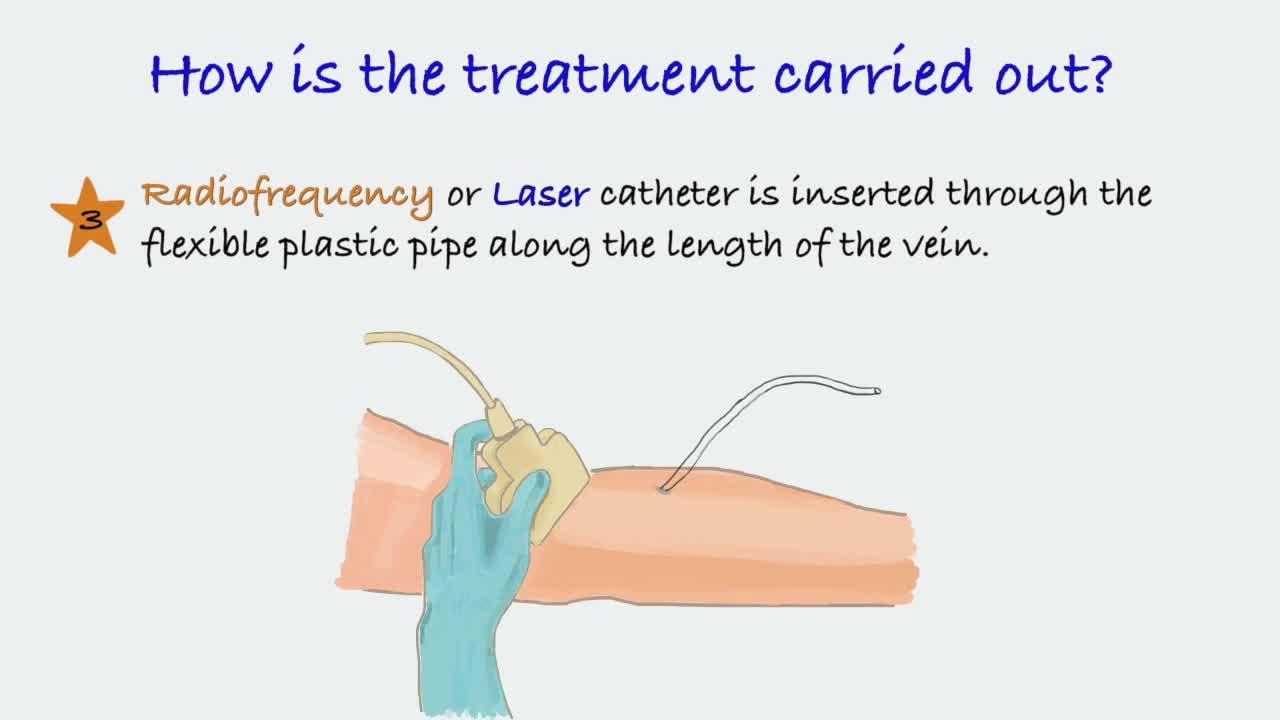
In this video, I'd like to tell you a little bit about ablation techniques, and those include radiofrequency and laser ablation for varicose veins. These treatments, in the same way as the open surgery, high-time strip that we discussed in a different video, they target the faulty valve leading to venous incompetence leading to varicose veins. And those faulty valves, as I mentioned in another video, are the points of communication between the deep and the superficial venous systems, that is to say the veins in the muscle and the veins just under the skin. So the way the ablation techniques work is firstly by doing an ultrasound scan. The ultrasound scan locates the vein, the long saphenous vein or the short saphenous vein, and they're located around the knee joint for the long saphenous vein and in the lower calf for the short saphenous vein. So we locate the vein using ultrasound and then we thread a very fine needle into the vein. Now that allows us to then advance a wire through the needle into the vein to give us some support. We remove the needle and then thread a very fine flexible tube over the wire. That allows us then to introduce the ablation catheter, whether that be laser fibre or radio frequency ablation. That catheter is then advanced into the vein and positioned very carefully, again using the ultrasound scan for guidance as to where to place the tip of the catheter. Once we're ready then to treat the vein, what happens is we deliver energy in the form of either radiofrequency waves or in the form of laser energy to the inside of the vein. That laser energy or radiofrequency energy cooks, in essence, or denatures the proteins in the lining of that vein wall. As we withdraw the catheter, after treating a segment, that lining becomes sticky and a bit of gentle pressure from outside causes the vein to collapse and wither away. Ablation techniques are what we call office-based procedures. They don't require general anaesthesia. They are typically done under local anaesthesia, although we can offer general if required for particular patients. Like I said, you walk in, you have the procedure, you put on a pair of special support stockings for some time after the procedure and you walk out. They're relatively painless procedures. No worse than a trip to the dentist at the very worst. You can return to work pretty much immediately. In terms of what you can do after the procedure, if you're having a simple ablation done, we advocate and advise you to take plenty of exercise immediately. You can go back to work if you do want to the same day. People sometimes ask about what is the risk of deep vein thrombosis, DVT, after you have endovenous ablation. And there is a risk. It is low, but it is an actual risk. It's probably in the order of 1 in 1,000 cases. We reduce that risk as far as we possibly can by giving an injection of a blood thinner at the end of the procedure. Also, with increased activity and wearing those support stockings, your risk is further diminished.

 Health Shared

Comments