Delivery of specialised lower limb care is a distinctive function of the professional phlebologist and vascular team which requires a high standard of professional communication to those seeking their advice and expertise, a necessary and important component of effective care delivery. Mr Lukla Biasi, PhD, Consultant Vascular Surgeon will be describing the complexity of mixed aetiology ulcers (arterial + venous) using innovative endovascular technology to treat arterial disease.
Transcript (auto-generated)
This transcript was generated automatically and may contain errors.
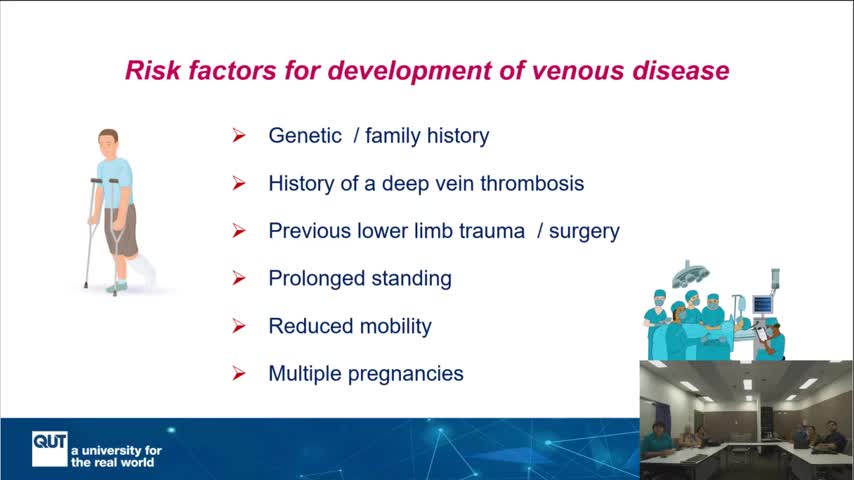
Hello, my name is Luca Biasi and I'm a vascular and endovascular surgeon at Guy St. Thomas' Hospital in London and the clinical director of Adintegrum Vascular and Bone Care. Many thanks to Ellie Linsley for the opportunity to join the Leg Club and the Vein Week. Today I would like to talk to you about the global pandemic of venous insufficiency and venous hypertension. Varicose veins are veins of the superficial network, mainly long and short saphenous veins that will have lost the ability of draining the fluid and the venous blood properly from the lower extremity back to the right side of the heart. This is mainly due to incompetent valves that should regulate the direction of the blood flow. Clinically, varicose veins and venous insufficiency may present with a very wide range of signs and symptoms that may vary from cosmetic spider veins that we call telangiectasias, to reticular varicosities will present with a diameter of less than one millimeter, to more advanced clinical stages where people develop this chromic and dystrophic skin changes. That means this coloration mainly at the level of the inner side of the ankle, the medial malleolus or in the pre-tibial area. That means on the anterior aspect of your shin. These color changes were mainly hemocedrine pigmentation and pigmentation may then progress into more severe pre-ulcerative lesions. And the ultimate stage of the venous disease is the development of leg ulceration. And a chronic venous insufficiency is a global pandemic. Half of the adult population have a minor signs of venous disease. And actually there is an equal distribution between men and women. And up to one third of the people, especially aging between 18 to 64 years, may have a truncal varicose veins or veins like you can see in the picture who have a diameter larger than three millimeter. And the truncal reflux is the condition that most often leads to the developing of a leg ulceration. And be aware that although more contemporary epidemiological data are lacking, we know that up to one to 2% of the people 65 years of age or older will definitely develop a leg ulceration in their life span. And the established risk factors include older age, pregnancy, any condition that exert an increased pressure in the upper trunk, for example, heavy weight lifting that is antagonizing the venous return, and most important of all, a family history of venous disease. On top of that, there are minor risk factors that are potentially linked to increase body weight index, diet, professional risk factors, sedentary work, desk base, job, all condition where there is a reduced ankle joint movement and calf muscle pump in action. The recent study by Gesta et al that has been published on the British Medical Journal at the end of 2020, as shown that there is an annual prevalence of wounds that has increased by nearly 70% in the last five years. And this has resulted in a substantial financial burden for the NHS and of course, into a severe deterioration of the quality of life of people who are affected by leg ulceration. In terms of NHS resources, that has meant over 50 million of district or community nurses visit and nearly 54 million of healthcare assistant visit or a practice nurse attendance to treat people who are presented with leg ulceration. And the annual NHS cost of wound management has been calculated in the figures of over eight billions British pounds, of which nearly 5.6 billions were associated just to the management of non-healing leg ulceration. This is nearly 80% of the overall cost for the community service in the UK. These figures overall highlight the need for structural change within the NHS in terms of leg ulcer, wound care and treatment. And the NICE guidelines recommends that patients who have leg ulcers which has not healed within two weeks from the onset should immediately be referred to a specialist of vascular service with the aim of undertaking a venous and possibly an arterial duplex assessment to identify the underlying reasons that may have led to the development of a leg ulceration. If your specialist vascular consultant identify a venous truncal reflux, which is amenable to endovenous treatment to keyhole procedure, there are options to treat your varicose veins with the aim of reducing the venous hypertension which is damaging your skin with innovative keyhole procedures. And under local anesthetic, mainly as a walk-in, walk-out procedure, we can engage your main varicose vein, perform a venipuncture and with a thermal heated catheter, either a thermal radiofrequency ablation or endovenous laser, we can ablate or block and reabsorb the vein which is responsible of the increased venous hypertension. This is a very effective procedure and a recent UK randomized controlled trial, the EVRA has actually shown the benefit of early endovenous ablation together with adequate compression therapy. In other words, by wearing a fitted or customized class two compression stockings or in the presence of the leg ulcer together with either a K2 or four-layer compression bandaging, endovenous ablation and compressional therapy as shown to be beneficial in promoting the healing of ulcers and reducing the risk of recurrences. But unfortunately, these are unprecedented times. The World Health Organization has declared that the coronavirus disease, the COVID-19 pandemic on the 11th of March, 2020. And this pandemic has immediately put extremely high demand on several healthcare resources, such as tertiary referral centers and critical care units. And this has resulted into a complete reorganization of the NHS healthcare system, both in the primary, secondary and tertiary care systems. The pandemic and the inevitable lockdown has inevitably ended up with reduced access to primary and secondary care services, redeployment of nursing teams, shift from face-to-face a consultation to virtual or remote consultation, and ultimately into a large emphasis on self-care management, which has proven to be very effective in the early phase of the first wave, but in the long-term means that people who have been experiencing leg alterations or early signs of venous hypertension have inevitably faced a delayed in specialist services and ultimately a chance to treat their impairing condition. On top of these, all the vascular services in London and to my knowledge in the UK have then stopped almost immediately to offer varicose vein surgery, not only to prioritize more life or limb-threatening condition, but only based on the compelling evidence that the coronavirus would present with thromboembolic, that means with clotting life-threatening condition, so that there were no evidence to support the safety the safety of varicose vein surgery in times of Covid. So now more than ever I would like to stress out the importance of Leg Club and other charity work to promote a social prescribing model, social interaction, engagement and ultimately with the view of raising self-awareness and to work together to identify a venous condition, to refer patients in the early stages of their venous disease to specialist service so that they can be timely assessed and possibly treated in the immediate post-COVID-19 era. We are now trying to create green pathways within NHS infrastructures and NHS hospital with the view of minimizing the exposures of patients to coronavirus in the main hospital facilities. And finally, let me spend a few words on a topic of which I'm very close, and I believe that we cannot forget in this time of crisis and inequality, the increase of homelessness, especially in our large cities like London. The homeless population, regardless their history of intravenous injecting or not have extremely high incidence of venous hypertension and leg ulceration. And we need to work together to get closer to this vulnerable cohort of patients. of patients, we need as physicians, as citizens, to remove the prejudice and the stigma upon the homeless and upon the people who have experience injecting drugs. I want to suggest you the read of the work of Dr. Gemma Geraghty, which is a vascular tissue viability nurse who has dedicated her expertise to the care of the homeless population. Listening to their stories is a way of reaching and approaching the homeless, gaining their trust and ultimately allowing healthcare professional to care for their condition. Once again, thanks to Ellie Linsley and the Leg Club to provide this essential service in times of COVID to raise awareness of the global pandemic of venous disease. Thank you very much.

 Health Shared


Comments