The importance of health prevention of lower limb-related issues.
Transcript (auto-generated)
This transcript was generated automatically and may contain errors.
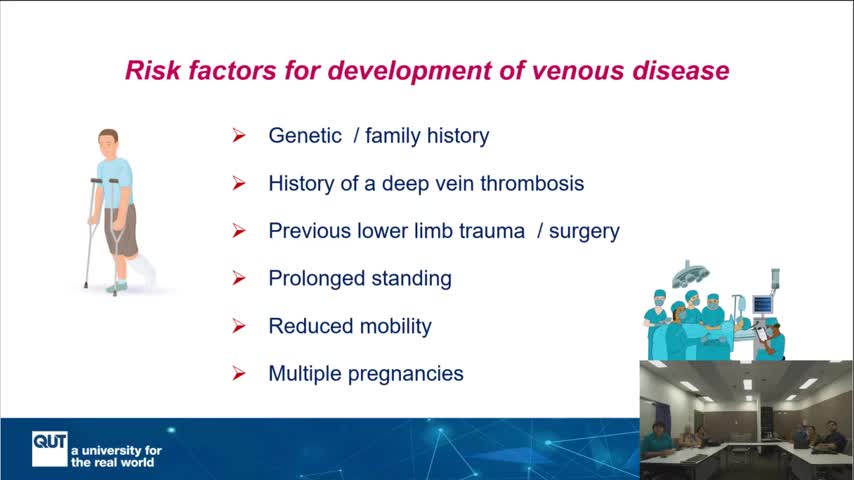
Good afternoon everybody and welcome. So I'm myself here in Queensland, Australia My name is Kathleen Finlayson from the School of Nursing at Queensland University of Technology in Australia and I have a group of students with me and we're just going to learn a little bit more today or have some thinking about how to avoid venous leg ulcers as part of the International Veins Week So I'd like to want you to think and remind yourself that prevention is always better than a cure and much better, I think, than having to end up with a venous leg ulcer and needing to cure it. So think about it with yourself. Do you think that you are likely to experience venous disease? So venous disease is a disease of the veins. It's not something we commonly hear about. However, as you can see from some of that information, it's very, very common. So up to 50% of adults have some degree of problems with their veins. They might be mild, might be mild varicose veins right up to quite severe disease where they have recurring venous leg ulcers for many years or decades. We know that 1% of adults will experience a leg ulcer, which is at the severe end of venous disease. We know that as we get older, the risk increases. So as we get older, over the 65s, you know, it can be up to 3%. Looking at studies of the over 80s, we're looking up to 5%. So the older we get, the more likely we are to have the more severe venous disease. Funnily enough, the commonest cause of leg ulcers is venous disease, even though you often might hear higher profiles with diabetic foot ulcers or arterial leg ulcers, but venous disease is the commonest cause. And unfortunately, if you do get to that stage with quite severe venous disease, even after you've healed your leg ulcer, up to 70% will recur after healing. So how do you know if you're at risk? So think about your family, your family history. Have you got a family history of varicose veins, sores on the legs, weepy, swollen legs at the end of the day, because this is actually one of the strongest risk factors of the genes you've inherited from your own family. If you've ever had some lower limb trauma in your background, so you played a sport, had a car accident or a bike accident, you may have a history of a deep vein thrombosis, and that can occur through trauma or from past surgery. So you might have had a knee replacement or a hip replacement. Also, you know, clotting problems, deep vein thrombosis often occurs with pregnancies. And we know that the greater the number of pregnancies, the greater risk you have of developing venous disease. Similarly, if you're actually working in a job that requires a lot of standing, particularly standing still, where you're not moving your lower limbs and getting that circulation moving, or if for one other reason or another, you're not walking around as much as you could be and have reduced mobility, We know these are strong risk factors for developing venous disease. Once we have venous disease, we also know there are some risk factors for getting recurrent venous leg ulcers. Obviously, the more severe disease, the more likely you are to have the ulceration. But then if you do have that history of having a deep vein thrombosis, a clot in your veins, if you are restricted in mobility for whatever reason. We know that if you are not looking after your legs and you're not attending health services regularly, if you have venous disease that you're actually more likely to break down again and get a new ulcer. If you have limited social support and even depression has been shown to be related to getting another leg ulcer. So how can we prevent it? This is the important thing. And I I have a little bit of a scary diagram up there, but just to remind us that in our circulation, we have two major forms of systems. And one is our arteries, where we take blood from the heart to our skin and our lower limbs and gives us fresh oxygen and food. And one is the veins, which is the dark blue one there, which return the blood from the feet back up to our heart again. So the veins are always struggling against gravity, which is particularly in humans with our upright posture, which causes a lot of problem. When we're thinking about, though, how to prevent problems with our veins, the first thing I have written there is a reminder to be really sure of your diagnosis and the cause. Know what is causing it. If you've got swollen legs, if you've got signs of venous problems, if you've got leg ulcers on your legs, make sure that you go and see somebody who can really accurately diagnose whether this is caused purely by the veins, whether you also have some arterial disease, which can also cause leg ulcers, whether you have a mixture of both venous and arterial disease, or whether it could be there are many other causes of leg ulcers as well. And having a really accurate diagnosis is obviously really important in being able to prevent those. So these are some of the things that we know can actually help prevent venous leg ulcers. Understanding your condition, so getting that accurate diagnosis and in understanding how it works. Closely monitoring. So make sure that you follow up and have well-legged checks with your health service provider regularly. And be aware if you can of the danger signs and the likelihood that your skin might break down. And if you look at the bottom of the slide you can see some pictures there of some legs which have got those danger signs very evident. So they're all people who've had ulcers in the past and who have healed who don't have an open ulcer at the moment, but you can see that there's signs of inflammation and venous eczema there, skin stoning which is quite common with venous disease, and also signs of swelling. So once your leg starts showing those signs, it's a sign that you really need to go consult your health professional to be able to prevent the next ones. Be assessed by a vascular surgeon. So if you do have venous disease, it's definitely you need to be referred to a vascular surgeon and see if there's an intervention there that might be able to help you and prevent. Keeping that circulation going, so moving the blood around and helping that blood go back up your veins to your heart, really important. And the best way to do that is ankle and calf exercises. So walking, heel raises, ankles circling, all these things you can actually do while sitting down if necessary. You know, they're really important for getting that blood going. If you have venous disease, it might also help you to actually pop your legs up and try and relieve some of that swelling at the end of the day. Compression therapy, which you might know as compression socks or hosiery or compression bandages or wraps, Velcro wraps you might have seen around, really important. And there's so many different types. And again, you need to consult your health professional about this and make sure that you get a type that suits you and that you're comfortable with and that you can use easily. And there are so many types available. There should be one that does suit you. And all that compression really helps you do is to push that blood back up those veins, back to your heart. So it's keeping that circulation going and stopping the swelling occurring in your lower limb. And support. Having support with social support as well as support from your health professionals, we know, really important in being able to keep those legs beautiful and healed. There's some general principles that can also help. One of them is skin care. know if you keep your skin in good condition, it's less likely to break down. So if your skin is dry, consider moisturizing it twice daily. Try and avoid keeping your skin too wet as well. So if you're in a climate where it's hot and sweaty, try and get that cool air. Avoid using the old fashion hard soap. We know that really dries out skin. And again, try and use a pH balanced non-perfumed cleanser on your skin. And again, if you have very fragile skin, it's getting thinner. Of course, as we get older, it does get thinner. You can protect it by wearing long sleeves, long pants, et cetera, and try and avoid that trauma to your skin, which sometimes then initiates a leg ulcer that doesn't heal because of the underlying venous disease. Good hydration and nutrition, also really important, we know, keeping that skin healthy. So just a reminder, prevention is always better than a cure. Keep that blood moving in your lower legs. Take care of your skin. Make sure if you do have a problem that you get an accurate diagnosis of your underlying conditions. Make sure that you follow up regularly with your health professionals to look after those legs. And then seek help if you see that any of those warning signs appear. Thank you. And there's just some further reading.

 Health Shared


Comments