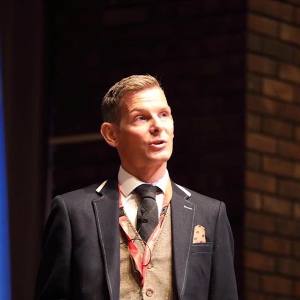
Consultant Colorectal Surgeon Mr Brendan Moran explains Multi visceral transplant for pseudomyxoma peritonei, at the time my opinions were none existent. By reaching out to Mr Moran and the team at Basingstoke Peritoneal malignancies institute we were able to look at other possible options for what was ultimately a terminal diagnosis.
Transcript (auto-generated)
This transcript was generated automatically and may contain errors.
Hello everybody, Adam has asked me to say a few words about his pathway to multivisceral transplant. Adam's diagnosis was in Australia where he was travelling with Laura and he came back and had an operation in Christie's Hospital in Manchester. At that time they opened his abdomen and found that they couldn't resect the tumour and they brought out an an ileostomy and placed a gastrostomy. In the beginning of 2015, I think Adam probably asked for a second opinion and I decided to admit Adam to the ward in Basingstoke so we could do another scan and have a chat. All we could see on the scan was the tumour was growing out through the abdominal wall beside the ileostomy and beside the gastrostomy. And having had the report from Manchester as well, I thought there was really nothing that we could do in Basingstoke. At that point in time, we had been involved with two multivisceral transplants in Oxford. The first patient unfortunately had died within a couple of weeks of surgery, and the second young woman who was still alive, probably eight or nine months after transplant. And I had that difficult decision, do I tell Adam and Laura about this option, which was very experimental, and I decided I should at least broach the topic. And now having seen Adam and Laura, you will see that Adam was up for anything that might improve the situation. And so what I did is refer him back for home TPN, at that point he was losing weight, he couldn't eat or drink properly, and referred him to Oxford. He was maintained on home TPN for a couple of months. And then one day on the 22nd of July 2015, myself and Tom got a phone call from the transplant centre, were we around in the country and are we available to come and help with Adam's transplant should it happen. So Adam was called into the hospital. The transplant team retrieves the multivisceral organs which involves the stomach, pancreas, duodenum, small bowel and transverse colon, thoracic transverse colon. We then went to Oxford, and it takes about two hours for the anaesthetist to put a patient for a metoosal transplant to sleep, and Tom Sessler and myself then commenced the operation to remove the abdominal wall and all of the organs apart from the liver, the kidneys and bladder. And it's quite a challenging operation but it does involve going behind the retroperitoneum and identifying what is ultimately only a couple of major vessels. So you identify the celiac axis and we leave the common hepatic artery in, we identify and tie off the inferior mesenteric artery. And you identify the portal vein coming by and all of the organs are then removed and you're left with a completely empty abdomen. And I know that Adam will probably show you this amazing picture of an abdomen which is really almost completely empty apart from the liver, kidneys and bladder. And then, of course, you have this extraordinary operation, which is the implantation of these organs back in, including replacing the abdominal wall. And I have to say, it still amazes me the complexity of this procedure. And in my sixth decade, after almost four decades in surgery, I thought this was the most amazing and futuristic thing that I'd ever seen in my whole life. And of course, recently, on the 22nd of July 2020, we have celebrated five years of Adam and Laura's journey in this amazing futuristic approach to inoperable abdominal tumours. And I think it's an inspirational moment for all of us to dwell on this and I know that Adam and Laura have been pivotal in this complex journey. Thank you very much.



Comments