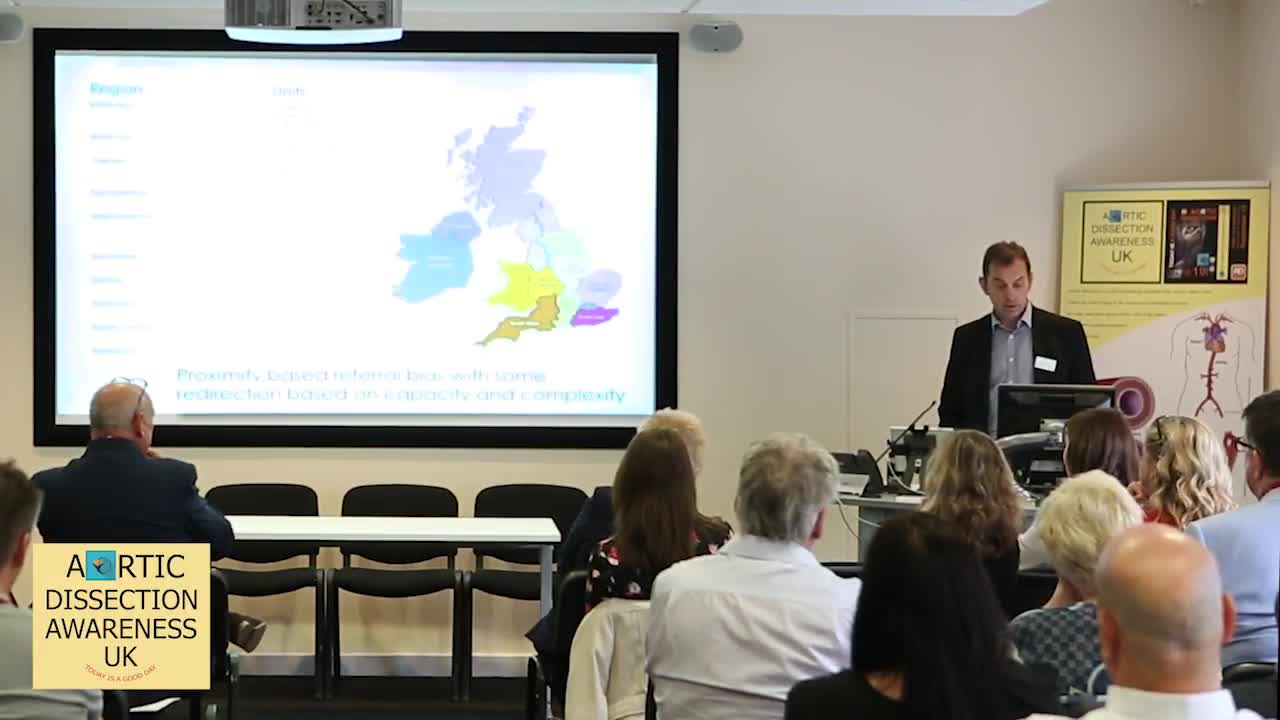
This is a video of the Aortic Dissection Awareness Day UK event starring guest speaker Jan Naybor, Lead Cardiac Rehabilitation Nurse Specialist.
Transcript (auto-generated)
This transcript was generated automatically and may contain errors.
Thanks everyone for asking me to come here and speak today about something that's you know one of a real passion of mine. I've worked at this trust for 31 years and I've worked in cardiology and surgery about various different positions and I've always loved cardiac rehab and I've been looking after cardiac rehab here for the last eight years and what you just heard there is a really big concern as well. Cardiac rehab has been going a long time and initially it was for patients who'd had a heart attack so a lot of focus was on those patients and then came along some of the conditions where we put a stent in so those patients started to come along to cardiac rehab and then we noticed patients were having bypasses and valves and it was, well, the commissioners, so the people who actually pay for cardiac rehab where you live, said, yeah, well, let's get those patients in as well. And more recently, we've been taking more patients with heart failure, because that's another group of patients that would really benefit. And if you think about what we do at cardiac rehab, everybody that's had any type of surgery would benefit from cardiac rehab when I show you what the elements are or people who've been to cardiac rehab. But as you rightly say, there's a lot, a lot of places that will call me and say, but I can't take this patient, I'm not commissioned, we don't have enough staff, we don't understand what we should do with those patients. So we're focused very much on patients who've had a heart attack or were a little bit frightened of patients who've perhaps got a dissection and have had surgery or patients who've had aneurysms. So it does cause quite a bit of sort of, there's a mixed bag of cardiac rehab going on across the country. That's kind of what you are when you come to us, when you come to Cardiac Rehab, that's how we kind of think. Your heart's in a couple of little pieces there, so it's not quite right, it's a little bit broken and you feel a bit like that, very frightened about what's next and we've just heard there about the fantastic opportunities for people to be experts and to do the surgery and then we don't want to send you home and then just say, right, that's it. We think of Cardiac Rehab really as just as important treatment as if you're having the surgery as well because this is the next step. So what's the benefits of cardiac rehab? Well that's the science really because it reduces all-cause mortality by 11 to 26 percent. No medication can do that so that's one of the massive big claims of cardiac rehab. Cardiac mortality so they're by 36 percent again no medications can do it's been proven statins and lipid lowering and other medications can't give the same outcomes as that. Generally the morbidity, so your survival. Unplanned admissions, now you might think well does that really matter for me but yeah once you're out of hospital we want to keep you out, we don't want to keep going back in with complications and having to go back in because every time you go back into hospital you're more at risk of developing something else. It improves your quality of life, so what does that mean? That's different for different people. Some people would like happy to just go back to doing something small. Some people want to get back, some people work, some people want to go right back and do everything that they did before. It's always possible with the type of surgery that you may have had, but the aim is to get you functionally back to your functional capacity, the best that you can be, and that's what rehab does. It supports early return to work. Lots of people younger have this condition. People want to go back to work. People don't want to just say, I've had a heart operation and that's me done. I just sit at home and do nothing and waste away. That's not what we want. It gives you the skills as well to manage your condition. Just seen the slide before there you probably have to be on medication you know there'll be some restrictions so you need some support to be able to manage those things because it's a lifelong thing that's going to happen to you afterwards as well it's not something that you're just gonna is going to go away. So if you're here with us then you will be referred to your local program and we do that by an electronic referral all your details will be on that full history full medical history so that your cardiac rehab nurse then can open that and see exactly what they're going to do. So what actually is it? That was the sciencey bit but what actually is it? So it's around about an eight to ten week program and that's a minimum of individualized program so it offers psychological support. What does that mean? That can be lots of different things. It can be the occupational therapist, it can be just a chance to sit and talk. A lot of people think oh cardiac rehab is that just where you go to have a bit of a NASA and a bit of sit around and talk well yeah it is but obviously it's got a key element of what it's doing but actually it is an opportunity to be with like-minded people who've had the same operation as you or similar who were all frightened it were all frightened you probably won't see as many people there with the same condition you'll probably see lots of people there's a thousand bypass and they've had stents put in but those people are frightened as well so that's a key element about what you do what's safe what can I do that's safe should I do, not enough or should I do too much and that's that's what we wanted it helps with. It's a big massive change it's a massive operation especially if you're coming in as emergency and it's very frightening and that's what we hope that rehab we can do is allay those fears and give you the those coping mechanisms to look after yourself. Physical activity well that's the stumbling block isn't it because what do you do too much or too little you just don't really know and we don't want you to do nothing and we don't want to obviously do more than you should so obviously it's all supervised so depending on what is on your referral all the nurse will have that ability to know how they'll manage your physical activity under supervision with the physios. Healthy lifestyle education and support it's just as important to carry on looking after your heart because you think oh this was my aorta that's got a tear and it's dissected but my heart's fine but we we don't know of our vascular, we know eating healthy, not smoking, moderate alcohol, all of those things help keep our brain healthy as well, they keep our kidneys healthy, they stop us getting, or can go a long way to stop us getting vascular dementia. So it's really important that we do look after those other things, even if we think, well, we haven't got any blocked arteries as well, it's all about keeping your cardiovascular health. So it's really important. pressure. We just touched upon that before. It's really important that we keep that blood pressure low. We don't want that blood pressure going high as well. So obviously to manage all that. So how could we do that with your blood pressure? Well obviously physical activity will help with that, but also we can help manage your medications as well. I know that a lot of patients who go to cardiac rehab, one of the things we know is that they do stay on the medications. That's something that patients are not very good at about probably about you know three or four months down the line suddenly they start forgetting to take them and they'll just pick and choose or you know and it's vital that you do take your medications you take them on time. We're only human and that's what that helps to do but the nurses in the cardiac rehab can actually type trace so they can actually change your doses of your medication so there's not the necessity to always have to pop to see your GP it's not as easy to go and just get an appointment everything can be done there for you so it's a one-stop shop. It's not in every cardiac rehab, but most cardiac rehabs now have got nurses or non-medical prescribers who can do that. And goal setting, so it's important no two people will be the same that come to cardiac rehab, no two people have had exactly the same operation or want the same things. So that's why it's an individualized program, so that you can set those goals. What do you want to achieve? It might be that you just want to do X, Y and Z. Somebody else might want to do the whole raft and that's why it's an individualized program and that you get from it what you need from it as well. The cardiac rehab is usually in your community setting and occasionally it might be in your hospital but more and more now are in the community setting and that's what we want you to sort of be you know a bit before when we said it's a little bit broken and it's just need to kind of put them together it's not it's not the miracle cure it's not you know we can't just suddenly go right you're fixed and everything's fine but that's what we hope at the end is that you've got all that knowledge and and that your heart is quite fit and that you can you can you can go on. These are the things I sent to just in response to the service when I was referring patients out I was getting lots of calls from lots of the staff saying I don't I can't take this patient I'm too frightened I don't know if they're still waiting for surgery or they've had it they've had surgery if they had the full lot are they coming back and having any more how stable are they what's their blood pressure need to be So rather than perhaps do a little bit of learning, a lot of the cardiac rehabs just said, well, we just can't invite these people, we just haven't got anywhere for these patients to go. So they've been turning patients down quite a lot. So we put this together, a colleague of mine who used to be the aortic nurse specialist here, we put this together, and we've given this to all of the cardiac rehab in Cheshire and Merseyside. And I'm the chair of the Cheshire and Merseyside Rehab Practitioners Forum. So we actually went out and did some education with all of those teams, we gave them some parameters, we gave them some blood pressure measurements, and we gave them this. And obviously, this is just a table. You've got to take everybody on their own face value and a full assessment. But it gave them a much better idea, so they're not turning patients away like they once were. Obviously, I think the most thing to pick out there is if you're still waiting for any surgery. If you've had the full surgery, then you can go on and you've got full rehab. You can do the, if you've got any residual dissection or anything like that, we do say there's no heavy lifting. So that's the key thing, but there's nothing stopping you doing all the other things, the chair-based and going to all the education classes. There is something for everybody to do. So they've got all of those. So what can our team do here if you're a patient here and you live in the locality here? Slightly different, it's quite an innovative programme, very tailor-made, they're not all quite like this. We do lead walks, we've got gym sessions, so supervised one-to-one. We've got a home program. We do encourage patients to come to Cardiac Rehab because you get that camaraderie of groups, but we know some people don't like that or are not able to, so we can offer a home program. We do lead cycle rides. And then we've got our traditional program alongside that, but people can break away and do lots of different things, and they can do some swimming as well. As I say, that's very innovative that we run here in the community. I spoke to my colleagues in Chester as well, which is not that far up the road. They don't see that many patients, but they are, again, another very innovative and very flexible service. So they tend to take you in, do a full assessment, and see what they can do. But they are fabulous, and they will offer you something. And they will definitely do something that fits you. It's not a one-size program for this. It isn't any patient, even if you have a heart attack, but definitely not for yourselves. So what can the other teams, so as I said before, we've been out and we've delivered training across Cheshire and Merseyside for those rehab teams, so you won't be getting turned away there if you live in those localities right across. We did some training in Manchester, because we know we've got a lot of patients that come from there, and we did some training there in Oldham. Obviously, we only managed to do a small bit because my colleague left then, but again, We know that there were a lot of the teams that were contacting us to say, we're just not sure what to do with these patients, so we just can't see them. The treatment, it does vary in different regions, and hand on heart I will say, there are some areas where it's not commissioned, it just isn't, which is a crying shame, and maybe we need to kind of push the cardiac people who are commissioning cardiac rehab to understand. My colleagues in Chester said they probably have had about five in a year, so not a great massive number. You know, obviously our own team here have not had that many through, so it's certainly as you said, it's not rare, but it's not common either as well. So we do need to do some work, we do need to push because it's not fair that a patient who isn't offered, and it can be quite embarrassing when we refer somebody here and we tell you all about what you might be offered and you get home and then you get a phone call or you don't get a phone call from your local cardiac rehab and you say, why can't I go? And it's really demoralising them to say, well, you're not commissioned or I'm not sure really we can't take you. And I have to explain that to a patient and that's not great. It's awful. Some of the rehabs will say, well, I will take most of the cardiac rehabs that do take patients who've had their surgery, do it on goodwill, they're not actually commissioned, so they're not actually paid to do it, but they know the benefit and they'll find a way and they'll take you to do your cardiac rehab, but some won't, some just are not able to break the rules. So there's a big gap, and we know there is a big gap. You were just explaining, Doctor, about that website that you can link into, and websites are great aren't they and then you can you can type in a blog there or ask a question but there's nothing like the real thing there's nothing like the face-to-face of actually coming to meet a specialist rather than typing in not everybody likes web platforms anyway this is where you see real people isn't it and you get to ask and you get to you know patients who've got fears about you know life-threatening disorders and and medication so they may not have had the same operation but they've got all the same feelings as you so there's a long way to go and we do and that's something that was on my radar but we will continue and I will continue to make sure that in the rehabs that I look after or have some you know I chair is that we keep up to date and that we keep doing learning we keep doing education and this is something that we will probably do on one of our next education sessions as well some awareness around this again because it was a while since we last did it as well but it's there cardiac rehab it just it needs to be there for everybody but if you come here you will be referred I promise you that and as I say we do I do liaise with some of the other rehabs as well and you do try to see if we can't get you in somewhere else or we can't offer you something as well but you will definitely get referred if you're here as well. Any questions? Just on one of the slides you showed about where you have to plan it, you said you do lead walks and swimming. We have some patients that can't walk their paraplegia and can't get to the community centres. You say you can come in to see us. Do you do any projects of home visits? Yeah, I know that our team do the home programme. There are quite a few in the room that can't get a bathroom. yeah so we do what we so we're very very intimate really because we can tailor make it so we've got a lot more on off we've got a fabulous you know if they can get somebody can bring them and we can go in the water with them or something like that we've got that opportunity but we can do stuff at home as well we could definitely we can we can hear saying we're very innocent but we've got that luxury but it doesn't happen everywhere. were showing on the IRAD website, I'm assuming that's based on best practice, experience, research, and how we can, you know, I'm saying not everybody would like to go online and get web support, but I'm assuming the advice that's out there is pretty proven, and how we can, it's maybe not for the Q&A today, but clearly there's an opportunity to share practice. Yeah, absolutely. There's definitely an opportunity when that is live for me to then disseminate that across that across Cheshire and Merseyside and to all my other colleagues it's our conference next week at cardiac rehab conference and the week after next as well so I do like to talk so I will mention it while I'm down there so the more we can share it and we can get that out and it's a supplement as well isn't it what we can offer if we can't offer anything at least we could direct patients to that as well families to that website or even take some parts of it and copy it and make it sort of tailor-made and bring it in so I'll definitely be able to disseminate that information out across Cheshire and Merseyside for sure. Yeah, yeah, most rehabs, they've changed the kind of, they used to be stage 1, 2, 3 and 4, and they've kind of changed that now to stage 0, and commissioning around rehab has gone up now, so they're offering longer sessions now, so there are some people that perhaps after the 6 to 8 weeks do need some more support, and that can often happen in more of a local gym or somewhere else in the community so they can refer you on to that next stage. There's lots of places that have got that extra support that can carry on and do a little bit more, or just carry on maintenance really, so if you've got an exercise programme or something, so you can carry it on so that you're able to then do that at home for continuation. And they offer reduced sessions to gyms or Tai Chi classes and things like that, so that's another way of finding in once you're kind because rehab does have a kind of finite point but we can extend it a little bit for some patients if they still need some more support.

 Health Shared



Comments