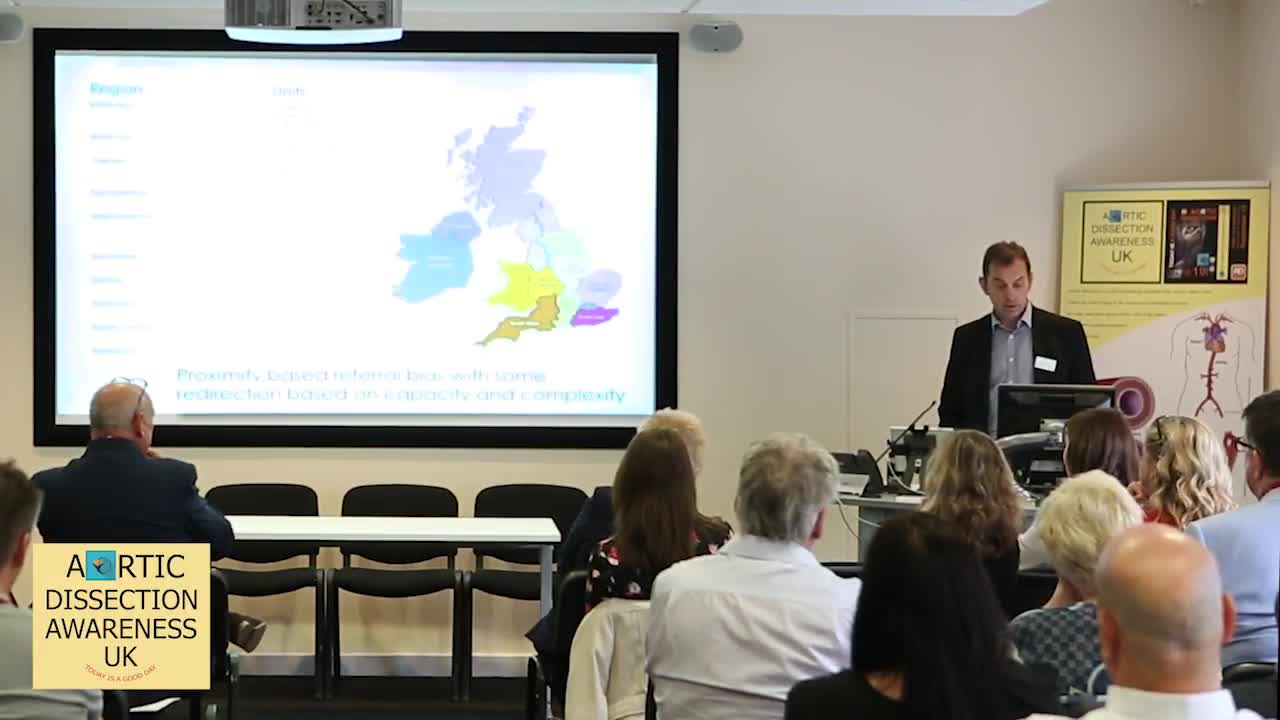
This video includes Gareth Owens discussing the importance of Aortic Dissection awareness.
Transcript (auto-generated)
This transcript was generated automatically and may contain errors.
Good morning ladies and gentlemen, I'm Gareth Owens, Chair of Aortic Dissection Awareness UK and Ireland. We are the National Patient Association for Aortic Dissection and a patient led movement for change, driving improvements in the diagnosis and care for those affected by this horrible disease. I'd like to share with you four reasons why aortic dissection awareness is important, then invite you to raise awareness of aortic dissection and to make change happen in the parts of the healthcare system that you can personally influence. To begin, I'd like you to imagine that you're in your favourite pub with some friends. It's It's a Wednesday night so you're just having a midweek drink and a catch up with some people that you know well. The bar is busy and you are standing chatting with a glass of your favourite tipple in your hand. The atmosphere is cosy, the conversation is interesting, you are relaxed and life feels good. Suddenly, without warning, you feel the most excruciating pain. It's as though an invisible hand with long fingernails has been plunged deep inside your chest and is now ripping downwards from your shoulders to your groin. The pain radiates to your neck, to your back and to your abdomen. You start to feel lightheaded and you manage to put your drink down just before your legs give way and you crumple into a booth that a worried looking couple have just vacated. The tearing pain is so bad that you instinctively fold your arms across your chest, raise your feet onto the bench seat opposite and push in the vain hope that this will stop the ripping sensation from going any further. You are filled with a sense of impending doom and you genuinely believe that you are about to die. In an instant your life has changed and is now hanging in the balance but you manage to turn and say to a friend, call an ambulance and tell them that I think I'm having an aortic dissection. This was my experience on the night I learned the importance of aortic dissection awareness. I am one of the fortunate few for whom awareness was the common life-saving thread running through the whole of my patient pathway. I knew I was having an aortic dissection because of my family history. My father died of the same condition at the same age. So my awareness of the symptoms and what to do if they occurred was high. The paramedics who picked me up were also aware of aortic dissection and they knew what to do, pre-alerting the major trauma centre and taking me straight there. The ED team at the Royal London Hospital were ready for me in recess together with the on-call consultant vascular surgeon and And within 30 minutes, I was in the donut of truth, having the only definitive diagnostic test for aortic dissection, a CT scan of my whole aorta. From there, I went for review by the specialist, aortic MDT at Bart's Heart Center, to whom I owe my life. And to cut a long story short, after two 10-hour open aortic surgeries, a few complications, and six months of left recurrent myelogeal nerve paralysis before I recovered my speaking voice, I eventually emerged as the brilliant outcome that you see before you today. So the first reason AD awareness is important is because it saves lives. I am alive today only because of the high level of awareness of aortic dissection that existed right across my patient pathway. From my own awareness as an at-risk individual, the paramedics, the ED and ICU teams, the cardiothoracic and vascular surgery teams, the cardiologists, the radiologists and my GP who are now responsible for managing my ongoing care and surveillance. Awareness across the whole pathway is crucial to saving lives and achieving good outcomes and that is what we are trying to create today with your help. The second reason AD awareness is important is because a lack of awareness causes misdiagnosis, delay and inappropriate treatment. One of our most challenging roles as the National Patient Association for AD is supporting the families of patients who have lost their lives because, for example, they were sent home from the ED with a diagnosis of gastritis or they waited days before someone agreed to do a CTAorta, or they were taken straight to the cath lab and treated for an MI. Can you imagine experiencing one of these things while your risk of dying from an acute type A aortic dissection is 1% an hour? Yet that the experience of many of our patient members. These are typical of the sad stories told to us all too often by relatives of patients who have died. The facts are that the diagnosis of aortic dissection is considered in less than half of patients who arrive at the ED with this life-threatening condition and that one third of patients with an aortic dissection are actively treated for a different, incorrect diagnosis. In 2018 we produced the Think Aorta podcast in collaboration with the Royal College of Emergency Medicine. It remains their most downloaded learning podcast ever. When I first heard it, I was shocked to hear an emergency medicine doctor say this. We miss aortic dissection. It's a time critical life-threatening disease. It's really it's classic emergency medicine. We miss aortic dissection. That's the tragic reality. As patients, as relatives and as healthcare professionals, many of us will know of tragic cases where aortic dissection was missed and these make us determined to ensure that it never happens again. While we cannot fix the mistakes of the past, the future is ours to write. For the third reason that AD awareness is important let me tell you about my dad who many years ago suffered an acute aortic dissection in the middle of the night and was taken by ambulance to hospital. Back then there was very little that could be done for him. AD was almost always fatal and my mother was told that he would most likely die. She spent the next few days by his bedside while I, considered too young to be told the prognosis, stayed with friends and continued to go to school. After a few days, mum arrived at school with a local vicar to tell me that my dad had died. We buried him on Christmas Eve and dad was taken from us far too early at the age of 49. I inherited Marfan syndrome from dad and after his death some well-meaning doctors explained to me that I was also at risk of an aortic dissection. I was 11 years old. They taught me how to recognize symptoms and they said that I should go straight to A&E if I ever experienced them. They also told me, aged 11, that my life expectancy at that time was 32 plus or minus 16 years. Back then, the picture in acute aortic dissection was very bleak indeed. The problem is that there is a lot of that old thinking still around. Only last year I received this quote from an eminent senior member of the medical profession who said patients with Marfan syndrome should resign themselves to the cardiovascular catastrophe that is their inevitable fate. Well no actually it's the 21st century and I am living proof that modern medicine can do far better. I also know some people and teams including members of our faculty today who are delivering great care and outcomes in aortic dissection. So our thinking about this disease definitely needs a reset. One of the things I often hear is that aortic dissection is a rare condition. Well, how rare is it actually? The data tells us that aortic dissection kills more people in the UK annually than road traffic accidents. and that data is likely to be an underestimate because we know that we have a serious problem of misdiagnosis. My good friend Amy Yazbek is a Hollywood actress and widow of the American actor John Ritter who died from a misdiagnosed aortic dissection puts this point much more eloquently than I can. It's not as rare as you freaking think. It's not as rare as you freaking think. It's not as rare as you freaking think. So the third reason AD awareness is important is that it dispels the myths and the old thinking which are preventing patients from getting the diagnosis and treatment that they need. I represent the new thinking that we need to adopt that with timely diagnosis and rapid transfer to a specialist aortic centre, patients with acute aortic dissection can do very well. So I hope that by now I've convinced you that in the UK and even here in the Wessex region we have a problem with aortic dissection that we need to solve. If you don't yet believe that then you should read the 2020 Healthcare Safety Investigation Branch report on delayed recognition of aortic dissection or just read some of the tragic coroner's reports. As the National Patient Association we brought this issue to the attention of government and requested action and in response the Secretary of State for Health and Social Care Matt Hancock said this. More people die from aortic dissection in England than in road traffic accidents. So it's absolutely essential we do everything we can to improve early detection and treatment of this life-threatening condition and frankly I don't think that awareness is high enough right now. Now on this point I agree with Matt. The fourth reason AD awareness is important is because we are not doing enough. We estimate that a national improvement in awareness and in diagnosis and in care could save up to a thousand lives a year. But whatever I or the NHS or the government says about this, it is people like you on the frontline who will make that difference. When it comes to stopping a patient who has arrived at 2 a.m. with an acute aortic dissection from dying unnecessarily and sparing their family from a world of grief and pain, we are in your hands. So in conclusion ladies and gentlemen AD awareness is important because it saves lives, it's important because we are missing the diagnosis, it's important because it dispels the myths and the old thinking and it's important because we are not doing enough. We need more awareness. So I want to ask you today from my heart. What are you prepared to do with what you learn at this event to help solve the problem? How will you raise awareness and what will you change where you work so that the 80 patients you encounter experience the happy path like I did and not the tragic path like so many others? Will you please commit to doing something to help us as a result of today. If you answered yes to that question, thank you so much. If you didn't, please ask yourself the question again at the end of the day. Thank you for listening to me as the voice of aortic dissection patients. Enjoy your day. Help us raise awareness of aortic dissection, and together, let's make a difference. Thank you.

 Health Shared




Comments