Natalie Phillips (Lymphoedema Clinical Nurse Specialist) provides an interesting talk explaining venous disease, the importance of looking after your legs and seeking advice.
Transcript (auto-generated)
This transcript was generated automatically and may contain errors.
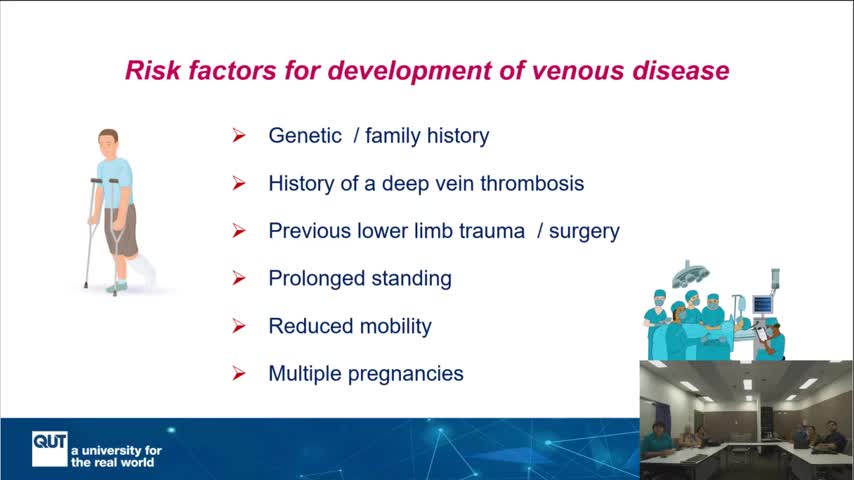
Hello, my name is Natalie Phillips, I'm a lymphoedema nurse specialist from the UK and I'm here today to just present a short session which is focusing on preventing and treating lower limb conditions. I'm proud to support the Leg Club in a campaign to save tomorrow's legs by shining a light on a hidden problem. The hidden problem being lower leg problems. How many times have you looked at that little prominent vein on your leg and not really thought anything of it? After a long day or after a long journey or after a long flight you may have a little bit of ankle swelling and again you just think that it'll just go away. Quite often that swelling will reduce, but in the presence of even the smallest of varicose veins, it is something that we should really get checked out. So in this short session, I will discuss the causes of those lower limb problems, in particular in relation to chronic venous insufficiency, so varicose veins, so problems with the veins, and why it's vitally important that you seek help early to prevent future complications. To understand why a person may develop leg problems we really must just understand how the human circulation normally works. The human circulation is made up of a complex network of organs such as the heart and lungs and vessels called arteries and veins. Put simply, the heart will pump blood around the body through its network of arteries, this blood and its blood plasma is rich with oxygen and nutrients to keep all the body's organs functioning as they should. These nutrients and oxygen leave the circulatory system at the smallest vessels which are called capillaries. They leave the system, go out into the tissues where they will bathe the tissue cells with those nutrients and oxygen oxygen. The remaining blood stays within the arteries and then passes into the smallest veins where it's then returned to the lungs to be re-oxygenated and then to the heart to continue that process. It's a process that is continual so it keeps going while our heart keeps beating that blood around the body. Now alongside that we have our lymphatic system which works with the circulatory system and can be defined as our body's waste system. It's our system for fighting infection or it's our army against infection. And the lymphatic system works to take away waste products from the tissues and the organs where it is filtered. That fluid is then filtered and then returned to the venous system via the veins that connect to our lymph nodes and the other major lymphatic and venous vessels near the heart. So when working properly, our bodily fluid balance and functions are maintained within the tissues. However, when it goes wrong, it can be as a result of a number of different causes. But for this session, we will just focus on the link that our veins and our lymphatic system have. So when our veins start to fail, we will often see evidence of small spider veins, either on the leg or around the ankle, often referred to as ankle flare. And this may be the first sign that we are developing a venous problem and results in the valves of the veins not being able to close properly. This not being able to close properly then stops the blood being forced back up to the heart. So it can lead to venous hypertension as the blood falls back down that vein. It's high pressure and backflow in the veins. As the blood flows backwards, it can leak back out of the vein into the tissues. And as time progresses, we may see skin changes or the skin changes color. It might become a darker, reddy-browny color, which is often called haemocydrin staining. Furthermore, if it's left untreated, the biggest complication of venous disease is that where we get a venous leg ulcer. In the presence of a venous leg ulcer we may also experience swelling and this is because our lymphatic system starts to become overwhelmed due to venous backflow and fluid leaking out into the tissues. At first the lymphatic system will be able to cope and will increase its capacity to be able to take up the fluid from the tissues but over time it will become overwhelmed and at this point you can clearly say that you've got a chronic oedema developing because of the link between how the lymphatics are failing and how the venous system isn't working properly. Complications if not treated early are, I've mentioned wounds, some people may develop what's called varicose eczema so itchiness and rashes on the skin as a result of the venous system not working properly. Where there is swelling present patients may develop shape changes on the limb, it may include the foot as well and because of the level of edema within the tissues this predisposes a patient to cellulitis. Now cellulitis is an infection in the skin that is caused because of the fluid that is sitting under the tissues and is starting to stagnate. We must remember that when there's fluid sat in the tissues that this fluid is full of waste products, cell debris and bacteria so it does predispose the patient, the person towards developing a cellulitis. So it's really really important again that we get these these symptoms treated early enough because there's lots of guidance and tips on how to improve leg health and manage venous disease such as simple leg exercises and elevation. And again there is a huge body of evidence that supports the use of compression garments in the management of venous disease and the management of chronic oedema and studies do suggest that you will reduce your risk of developing a cellulitis by wearing correctly fitting compression and that compression prevents the reoccurrence of venous leg ulcers. So it helps to improve the functioning of your venous and lymphatic system. So it's really important to seek help early because having a leg wound means having never really having a good day but by working together the Leg Club and the VWIN Foundation has sought to raise global awareness and improve prevention of venous and lymphatic health problems by supporting the International Awareness Week but most of all by encouraging those with leg problems to seek help as early as possible. Thank you for listening.

 Health Shared


Comments