

Open adrenalectomy

Description
Open Adrenalectomy is an invasive surgical procedure involving removal of either one or both of the adrenal glands. The surgery is performed either as a result of either adrenal malignancy or large pheochromocytomas that cannot be safely removed laparoscopically.
The surgery is performed under general anaesthesia and full recovery time is between 4-6 weeks, with the patient being kept in hospital 4-5 days after the procedure before discharge. Depending on individual patient situations, and whether a bilateral adrenalectomy was performed, the patient may be required to take continuous lifelong medication to replace and maintain healthy levels of adrenal hormones; an integral part of the long term care that post-adrenalectomy patients require.
Complications of the surgery are more common in the open adrenalectomy approach compared to the laparoscopic technique, and range from wound infections to more severe complications including damage to nearby visceral organs and heavy intraperitoneal bleeding.
What is it?
The adrenals are a form of endocrine (hormone secreting) glands that are located above each of the kidneys. The adrenals are formed of many different layers broadly fitting into either the adrenal cortex (outer area) or adrenal medulla (core), with each layer producing a hormone that is vital to the continued functioning of the human body. These include:
- Aldosterone - This hormone regulates the level of salt in the body.
- Cortisol - This hormone is useful in the stress response.
- Adrenaline - This hormone is involved in your typical “fight or flight” response.
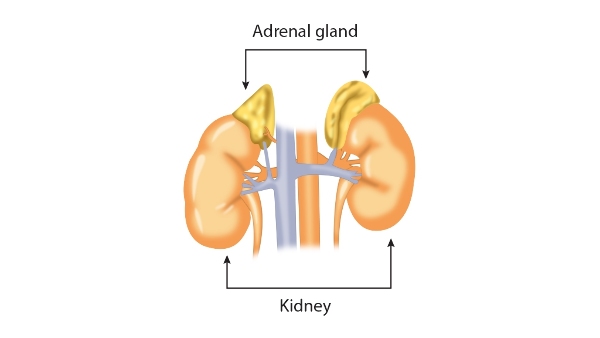
Either one or both of the adrenal glands are removed in an adrenalectomy, depending on whether the disease has affected both the left and right adrenals. Open adrenalectomy refers to the removal of the adrenal glands after opening up the abdomen through an invasive surgical incision, rather than through the minimally invasive laparoscopic procedure (1).
Why is it done?
The removal of the adrenal glands can either be performed through a laparoscopic (minimally invasive) or open (invasive) approach. The exact procedure conducted depends on a combination of both patient factors and surgeon preference. One of the main factors which determines the choice of approach is the exact nature of the tumour.
The tumours which are most suitable for removal via an open approach include very large pheochromocytomas (>8cm) or if adrenocortical malignancy (cancer in the outer zones of the adrenal glands) is present (2). Malignant tumours within the adrenal gland can spread to nearby structures including the:
- Inferior Vena Cava
- Liver
- Spleen
- Pancreas
Hence when malignancy is suspected, an open approach allows further resection of any other affected organs if necessary. While Pheochromocytomas are generally benign, up to 10% are malignant which is usually indicated by their large size on imaging.
Occasionally, conversion from a laparoscopic approach to an open procedure is necessary. This occurs in between 3% - 5.5% of laparoscopic adrenalectomies and can be due to a number of factors including:
- Large size of the malignancy/tumour such that removal by laparoscopic means is not possible nor safe.
- Discovery of malignancy not noted on previous imaging which may warrant further exploration to investigate for metastasis.
- The tumour being adhered to associated structures such that an open approach is required for easier access and mobilisation of associated organs (3, 4).
If conversion to an open procedure is required, an incision is made below the ribs on the relevant side by connecting the port incisions in a curved line.
Anaesthesia
The procedure is formed under General Anaesthetic and typically lasts between 3-4 hours. On the day of your operation, you will meet the Anesthetist who will go through the procedure and discuss any concerns or questions you may have. Because general anaesthetic will be used, you will be unconscious throughout the surgery. As a result, an endotracheal tube will need to be placed down your throat to help you breathe (see diagram below).

Will I need to do any preparation?
Before your Laparoscopic Adrenalectomy, you will attend a pre-admission clinic with the surgeon to discuss the surgery and organise any tests that need to be conducted before the procedure is performed. You will undergo a series of steps to evaluate the tumour before the surgery. These are as follows:
- Biochemical testing of adrenal function - This is typically conducted via either a blood or urine test depending on the nature of the tumour suspected.
- Conducting scans to locate the position of the tumour - This may include X-Ray, CT, or MRI scans depending on the exact nature of the tumour. If malignancy is suspected, the doctors will look to see if the cancer has spread to any nearby organs (6). If multiple organs have been affected by the cancer, your doctor will speak to you about the need to operate on and partially resect the different affected areas. This may mean that different members of the Multidisciplinary Team form part of your care, such that you receive the best possible care from different specialists.
- If your doctor suspects a pheochromocytoma, you may have to undergo a course of blood pressure medication involving alpha and beta blockers to make it safe for the surgery to proceed (7).
On the day of the surgery, you will be given some antibiotics to reduce the risk of infection during the procedure. In addition to this you will be given stockings to wear to prevent blood clots forming in the deep veins of your leg (Deep Vein Thrombosis). Patients undergoing an adrenalectomy may experience nausea post-surgery, and hence an antiemetic medication can be given to help relieve the sensation of wanting to throw up. On the day of the operation you will be expected to fast from 6 hours before the operation, with not having anything to drink 2 hours before.
If you have been diagnosed with a pheochromocytoma and you have a family history of endocrine tumours, your surgeons may recommend genetic testing or scans of other parts of your body to check for the presence of inherited disorders such as Multiple Endocrine Neoplasia, although these are quite rare (8).
The Surgery
Open Adrenalectomy can be performed in any of the following three methods:
- Transabdominally - This is where the surgeon enters through the front of the abdominal wall.
- Retroperitoneally - This is where a posterior approach (through your back) is used to access your adrenal glands.
- Transthoracically - This is rare and the surgery is only conducted in this manner when the tumours are very large such that they involve the diaphragm or have extended into the chest.
Transabdominal Adrenalectomy is often the approach of choice and can be conducted either in an open manner, or via laparoscopic minimally invasive techniques. The surgery takes between 1.5 - 3.5 hours.
The steps of open adrenalectomy are as follows:
- After being given a general anaesthetic, you will be positioned supine (lying down on your back) with the side being operated on elevated with a soft cushion.
- A choice of two incisions can be made based on surgeon preference:
- Midline Incision (right diagram)
- Subcostal Incision (left diagram)
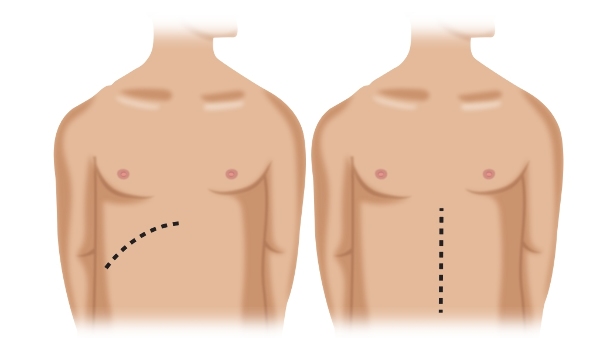
- Once the incisions have been made and the surgeons have gained access to your abdomen the surgeon will first attempt to mobilise any surrounding structures, which involves dissecting any adhesions to give the surgeons a better view of the area. For a left adrenalectomy this includes mobilising the spleen, which will allow them to identify the left adrenal vein. For a right adrenalectomy, this includes mobilising a part of the liver known as the hepatic flexure by dissecting the falciform and lateral triangular ligaments. The surgeons will follow either the left or right adrenal vein to identify the relevant adrenal gland.
- For smaller masses, the adrenal vein is often dissected first and then the surgeon will move onto the actual adrenal gland. For larger masses, the surgeon may choose to dissect the adrenal gland first and then move down along the vena cava to reach the adrenal vein.
- The adrenal gland is dissected using a sharp instrument, while the small vessels including the adrenal vein are ligated using either electrocautery or using dissection. For a left adrenalectomy, dissection starts lateral (towards the outside of the body) to the spleen. For a right adrenalectomy, the dissection starts at the triangular ligaments which join with the liver.
- The adrenal veins and any other accessory vessels are ligated using surgical clips or sutures to prevent any postoperative adrenal bleeding.
- If the tumour has invaded the inferior vena cava, a further resection may need to be made. This includes mobilising the adjacent liver to ensure it is damaged during inferior vena cava resection. The part of the inferior vena cava that has been invaded by the adrenal malignancy is resected away and a nonabsorbable monofilament suture is used to repair and join the remaining portions together. Vascular bypass may be necessary in certain situations, and extreme care needs to be taken not to damage the arterial vessels branching from the aorta posterior to the inferior vena cava (9).
- If the adrenal malignancy has spread to any nearby organs such as the spleen for left adrenal cancers, and the liver and pancreas for right adrenal cancers, parts of these organs may need to be resected.
- If the dissection is extensive, as is often the case with open adrenalectomy procedures, a closed-suction drain can be placed to remove fluid build up (2).

Post-Operation
After the operation you will be taken to a recovery room where you will be woken up and your vital signs monitored. You can begin to drink fluids and start a soft diet within 24 hours after the operation has finished. If you have cushing’s syndrome, you will be given injections of hydrocortisone until you begin to start a regular diet. You will be expected to stay in hospital for between 4-5 days where staff will monitor your vital signs.
Caring for yourself at home
Removal of the adrenal glands means that you may be required to continue taking adrenal hormones to compensate for the lack of adrenal function. This will particularly be the case if both adrenal glands are removed, or where only one is removed but there is limited capacity and functionality in the remaining adrenal gland. Hence before discharge, the surgeons will discuss and prescribe you with the appropriate medication to ensure you maintain a healthy level of hormones. It is important to continue taking these medications to prevent adrenal insufficiency (Addison’s Disease). These medications may include prednisolone to replace the cortisol, and fludrocortisone to replace the aldosterone (10).
Your doctor should explain to you about how to take these medications, particularly during periods of time where you may be more stressed than usual. During these times e.g. when you are going for surgery or experiencing personal stress etc, you should take more cortisol than your standard daily dose as you will lack regulation from your adrenal glands. This helps you compensate for the lack of adrenal function better (11).
You will be able to slowly return to your normal daily activities once your pain settles down, however expect full recovery to take between 4 - 6 weeks depending on the extent of surgery. If a malignancy has spread to another organ within your body, there may be additional procedures/medications that you need to take such as chemotherapy or radiotherapy. An oncologist (cancer specialist) will work with you to ensure that you receive a comprehensive treatment plan even after discharge from the hospital.
Comments